[Note: A selection of charcoal images is now available for purchase and download from the Image Market – HERE.]
If you travel virtually anywhere in rural Africa you cannot fail to notice a growing environmental crisis – deforestation caused by charcoaling. All households have basic energy needs which have to be met in the preparation of food, heating, boiling of water and other requirements. Traditionally these needs have been met with the use of fuelwood. With ever growing urbanization throughout Africa, fuelwood is not an option – the vegetation is just not available in urban fringe areas. Other options of electricity, kerosine and LPG gas are beyond the affordability of the vast majority of the poverty stricken urban fringe populations across the continent and so charcoal has become the only possible choice.
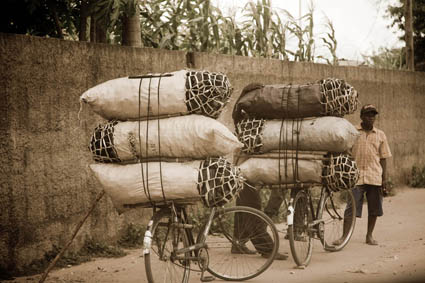
Producing charcoal, transporting it and selling it has also become big business in the subsistence economies of African countries, estimated to be at least as large a part of the economy as cash cropping. Charcoal is produced from wooded or forested areas through the heating of wood in makeshift kilns and reducing it to its primary carbon content. Whilst the use of charcoal itself as an energy source is more efficient than wood burning, the combined processes of creating and using charcoal has the same net effect as wood burning and is a major contributor of CO2.
Development agencies and governments throughout the continent have been trying to resolve the problem with varying degrees of success. In some countries the practice has been outlawed but this has had little impact other than that of driving the process underground, making it even more difficult to control. In other places programmes have been established to promote better forest and woodland management – again with limited success. The long term impacts of deforestation are extensive. Erosion results in reduced soil fertility and sediment deposition in streams and rivers causing an increasing threat of floods. Groundwater recharge is diminished due to increased surface runoff which means that the boreholes which many communities depend on for fresh water risk drying up and streams stop flowing which brings the threat of drought ever closer.
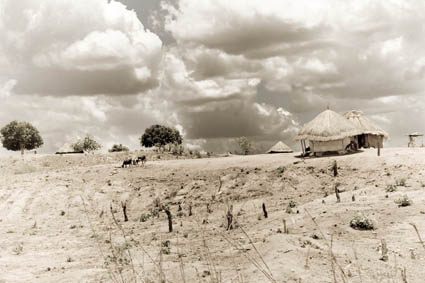
Charcoaling and the resultant environmental impacts are symptoms of the vast underlying effects of poverty on a continental scale. As population pressure increases in both rural and urban contexts, people and households are pushed ever deeper into survival strategies which are of necessity short term with immense long-term consequences. Without doubt the greatest environmental threat in Africa is poverty, not development. Charcoaling is a good example of one of the central dilemmas of development – you cannot solve the problems of an single sector (whether it be social forestry, education, health, food security, etc.) in any sustainable way without addressing other related sectors. Broad growth and development is needed to raise the chances of fixing specific sectoral problems.
Are there solutions?
What does the future hold for the coming generations? It is a tribute to the resilience of youth that in these stark conditions the same inherent quest for life is evident in the eyes of young people as you will find anywhere.
I took this series of images in the Sofala Province of Mozambique. For thoughts of capturing the essence of such dilemmas, see the blog entitled Its in the Eyes – Images of degradation
Links to further info ….
For further information see this article on the FAO site (the Food and Agricultural Organisation of the United Nations): Charcoal production and use in Africa: what future?
A very informative site on household energy needs and charcoaling in other parts of the world is The Charcoal Project – have a look at their site.

4 thoughts on “Charcoal and deforestation”
Comments are closed.