I spent some time in the woods on the North Downs in Surrey near Caterham yesterday to enjoy a rare sunny day with Toffee Dog and my cameras, trying to capture the mood of the woods in the midst of winter. The creepers entwine themselves around the trees in tight spindly embraces which constrict and smother. A touch of green promises warmer times to come.
These images are available individually in 40 x 16 inch (1.0 x 0.4m) panels or as a set of 4 panels in either Acrylic or Blockmounts. Contact Len Abrams for details.
[Note: A selection of charcoal images is now available for purchase and download from the Image Market – HERE.]
Uganda and Ethiopia
Charcoal market in Addis Ababa, Ethiopia
I have added to my collection of images showing the impacts of the wide spread practice of charcoal making on the environment in Africa, which results in vast areas of deforestation. (See the images in the Season Images Gallery.) The use of charcoal as a cheap household energy source is just about the only option open to the ever increasing urban fringe populations where firewood has long since gone and other options such as LPG or electricity are either not available or are too expensive. For a more detailed comment on charcoaling, go to my blog entitled “Charcoal and deforestation“. On travels in Africa at the end of 2010, I captured images in Uganda and Ethiopia of urban charcoal markets – a key element in the supply chain.
Kigali – the cleanest city in Africa?
Kigali, Rwanda - Sorting garbage
I also visited Kigali in Rwanda where there is a surprising initiative underway which has resulted in the cleanest African city I have ever seen – not a spot of garbage anywhere. A cooperative called Association for the Conservation of the Environment (ACEN) which makes briquettes from garbage as an alternative to charcoal. Garbage is brought in to several centers throughout the city and paid for – providing a marginal income for some of the poorest and resulting in the cleanest African city I have ever seen! The garbage is separated before the organics are shredded, dried and molded into briquettes – the inorganics are recycled. This results in less demand for charcoal and less pressure on rural environments, which, together with a cleaner city is a win – win for everyone.
I used the period between Christmas and New Year (and the thaw from the recent ice and snow!) to go with Karen (my wife) to the English midlands and photograph a further 5 cathedrals. There are 43 Anglican cathedrals in England and with the recent 5, (Manchester, Liverpool, Wakefield, Blackburn and Sheffield) I have now reached 35.
Manchester Cathedral
Manchester Cathedral
We traveled to Manchester first – construction of the church which was the predecessor of the cathedral began in 1215. The church became a cathedral in 1847. It has been through a long history of restoration and reconstruction, it was bombed in World War II and by the IRA in 1996. It is a somewhat brooding building. See the Manchester Cathedral Images here.
Liverpool Cathedral
Liverpool Cathedral
Liverpool is the largest cathedral in England and the largest Anglican cathedral in the world – it is truly amazing. It is a 20th century cathedral – designed by architect Giles Gilbert Scott, who was 22 years old when he won the commission. Begun in 1904, it was completed in 1978, 18 years after Scott died. The bells of Liverpool Cathedral are the highest and heaviest ringing peal in the world and the organ is the largest in England with 10,268 pipes. The whole experience is one of audacious magnificence at scale! See the Liverpool Cathedral Images here.
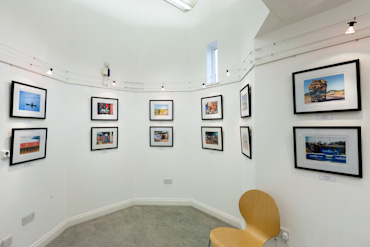
I held my second exhibition from 8 – 14th December, 2010 at the Gardens Gallery, Montpillier, Cheltenham in England.
The Gardens Gallery is a great venue – plenty of space and well lit. Exhibiting at this time of year in England is not the greatest time – it was cold but generally dry. We had a total of just on 200 visitors. Christmas sales helped me to break even but this is no easy way to make a living!
It was with some trepidation that I attended the Royal Photographic Society Associateship Assessment Day on 13 October 2010 at the Society’s headquarters in Bath, England. I had entered the required panel of 15 images in the Visual Art category. My panel comprised images from a series I have been working on over the past couple of months – English Cathedrals. After a very interesting look at some awesome presentations by other photographers, of which slightly less than half were awarded the distinction of Associateship, I am pleased to say that my panel was successful and I am now an Associate Member of the Society.
Statement of Intent
The cathedrals of England hold a tension, an irony, being at once places of devotion and contemplation as well as representing wealth and power from a past era. The tension runs right through most elements – a warmth and a coldness, the familiar with the alien, minute detail overshadowed by vast lines and cavernous spaces. My purpose in these images is to explore these tensions. The images represent a small selection from a project to photograph all 43 Anglican cathedrals in England, seeking not to create an architectural record but to capture unique perspectives to be reflected upon over time and which are not initially obvious. All the images have been taken in available light and generally without the presence of people, concentrating on the creation of art out of art – creativity out of the creativity of past eras.